Sell Mineral Rights
in Weld County,
Colorado.
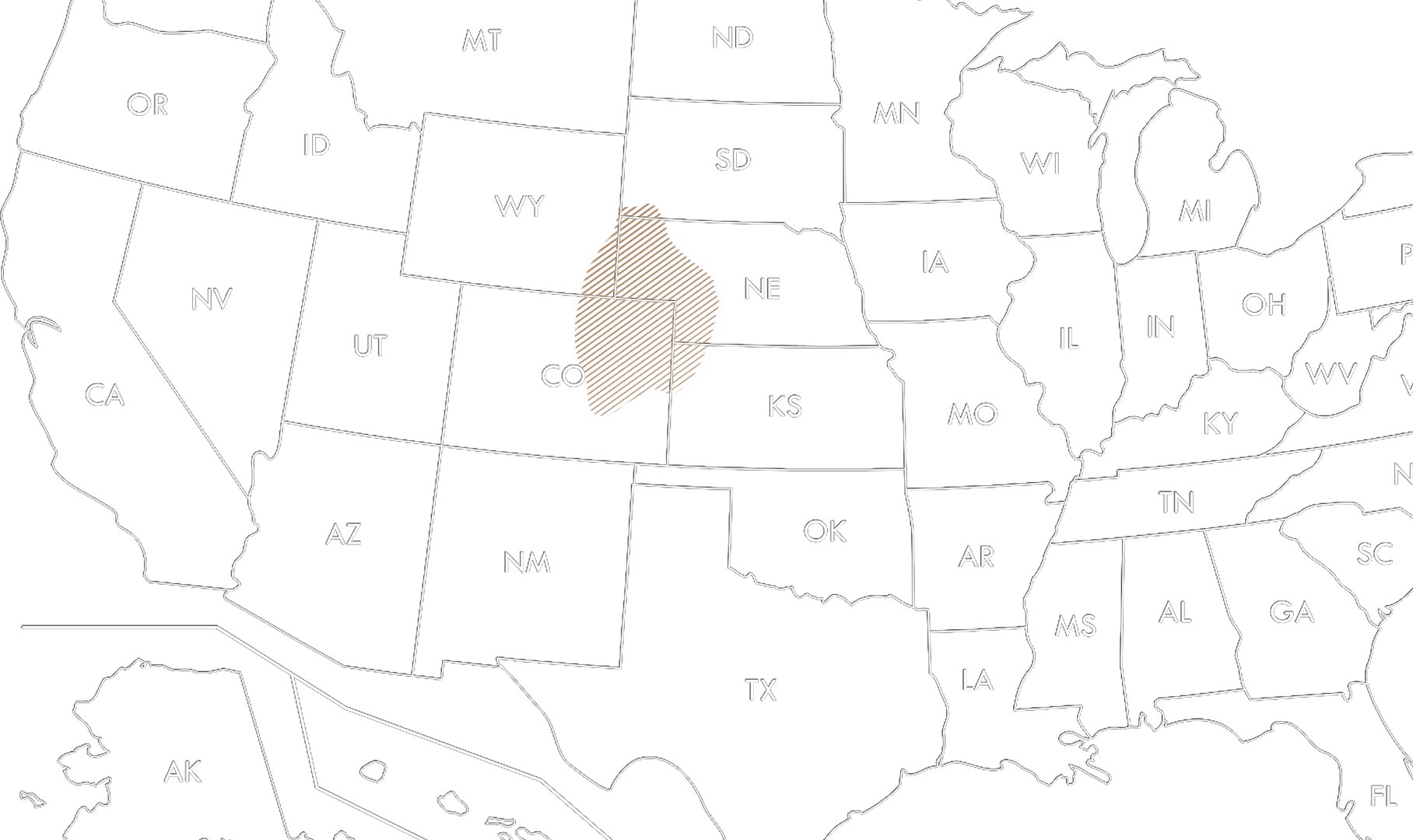
Weld County is one of the most active oil and gas counties in the country, and the core of Colorado's DJ Basin. If you own mineral rights here, you probably have questions. We are happy to help you sort them out.
A quiet empire under
the high plains.
East of Denver, the land rolls flat toward Nebraska. What you do not see from the road is the 8,000 feet of rock beneath it, and the oil those rocks have been producing for decades.
Weld County sits above the Denver Julesburg Basin, known to the industry as the DJ. At its heart is the Wattenberg Field, and at the heart of Wattenberg is Weld County itself. The county accounts for roughly nine of every ten barrels of oil produced in Colorado.
If you are reading this, you probably own a piece of that. Maybe it came through a will, a letter showed up in the mail, or you just want to understand what your royalty statements are telling you. This page is for you.
The short answer to the question everyone asks first is usually yes, your minerals have real value. The longer answer depends on where in Weld County you own, which formations lie beneath you, the operator, and your lease terms. We walk through all of it below.
Have minerals in Weld County? Send us what you have and we will take a look.
Stacked pay. Many zones,
one spacing unit.
Most oil and gas basins produce from a single target formation. The DJ Basin produces from several. For mineral owners in Weld County, that is not a trivia fact. It means the same acre of minerals can generate royalty income from multiple wells targeting different rock layers at different depths.
The Niobrara is the primary target across most of Weld County. It is a calcareous shale deposited during the Late Cretaceous, when an inland sea covered what is now the American interior. The formation is divided into three benches, labeled A, B, and C from top to bottom. The B bench is the most widely developed, though operators in the core of Wattenberg routinely drill all three benches on the same spacing unit.
For a mineral owner, the practical consequence is that a single 1,280 acre drilling and spacing unit can contain six to twelve Niobrara wells stacked across the three benches. Your decimal interest applies to each of them.
The Codell sits just below the Niobrara C bench and is the second major horizontal target in Weld County. It is a thin tight sandstone, typically 12 to 25 feet thick, that responds well to modern completion designs. Codell wells are often drilled on the same spacing unit as Niobrara wells, adding another layer of royalty income for the underlying mineral owner.
Early Codell development in the late 2010s surprised the industry with how productive the zone could be when completed aggressively. It is now a standard part of most Weld County development plans.
The J Sand, sometimes called the Muddy or Dakota depending on the operator, is the historical conventional producer of Weld County. It was the target of thousands of vertical wells during the Wattenberg boom of the 1970s and 80s. Modern horizontal activity in the J Sand is limited but does occur in certain structural positions.
If your minerals have been producing since before 2010, there is a good chance your legacy royalty income originates from a J Sand well.
Who is drilling on your
Weld County minerals.
The operator matters. A top tier operator with capital discipline and a long development queue turns your mineral interest into reliable royalty income for decades. An undercapitalized operator can tie up your acreage for years without producing a barrel. Here is who is doing what in Weld County right now.
We know how these operators develop in Weld County. Happy to give you context on yours.
Not all Weld County
minerals are built the same.
Weld County covers almost 4,000 square miles. Where your mineral interest sits inside that footprint matters a great deal. Core Wattenberg acreage trades at entirely different values than fringe or emerging areas. Here are the sub areas we track.
R66W-R68W
R64W-R69W
R60W-R68W
R55W-R62W
R65W-R68W
R69W-R71W
What your Weld County
mineral rights are worth.
There is no universal formula. Valuation is a function of current production, future development, operator quality, lease terms, and market conditions. What follows are the four scenarios we see most often for Weld County mineral owners, along with the specific factors that shape value in each.
We would rather look at real facts than speak in generalities. Send us what you have.
Colorado is not a simple
place to drill.
Weld County mineral values cannot be separated from the regulatory environment. Colorado oil and gas regulation has evolved significantly over the past decade, and the changes have real effects on how your minerals are developed and what they are worth.
SB 19-181 and the shift to public health primacy
Senate Bill 19-181, passed in 2019, fundamentally changed Colorado oil and gas regulation. It shifted the mission of the state regulator from fostering oil and gas development to prioritizing public health, safety, welfare, and the environment. The Colorado Oil and Gas Conservation Commission (COGCC) was restructured and eventually renamed the Energy and Carbon Management Commission (ECMC).
For mineral owners, the practical effect has been longer permit timelines, increased setback requirements, and greater weight given to local jurisdictions in permitting decisions. Existing permitted locations and producing wells have become more valuable because replacing them has become harder.
Setbacks and the 2,000 foot rule
Current setback rules require oil and gas wells to be located at least 2,000 feet from occupied structures in most circumstances. In rural Weld County this is generally not a binding constraint, but along the southern Weld and Adams County boundary where development meets suburban growth, the rule has reshaped what is possible.
The result is a two tier market. Acreage with existing permits or production carries a premium because those positions are grandfathered. Undeveloped acreage in constrained areas may be effectively non developable, which reduces its mineral value.
Forced pooling in Colorado
Colorado allows forced pooling through the ECMC, but the process is more stringent than in some other states. An operator must demonstrate good faith negotiations with mineral owners before a pooling order can be issued, and unleased owners are typically assigned a 13 percent royalty with a risk penalty on their pro rata share of well costs.
If you own unleased minerals in Weld County and you receive a pooling notice, you generally have options. You can negotiate a voluntary lease before the hearing (usually preferable), you can participate as a working interest owner (rarely the right move for passive mineral owners), or you can accept the terms of the pooling order.
The real questions
mineral owners ask.
We have been through these conversations hundreds of times. Below are the honest answers to the things people actually want to know.
Find out what your
Weld County minerals
are actually worth.
Send us what you have, or what you think you have. We will pull ECMC records, check operator activity in your section, and put together a plain-English summary with our reasoning laid out. If it makes sense to go further, we move on your timeline. If not, you have a free breakdown you can take anywhere.